
Ẹdema «Jade» Ubọmwẹn
| Ẹdema «Jade» Ubọmwẹn | |
|---|---|
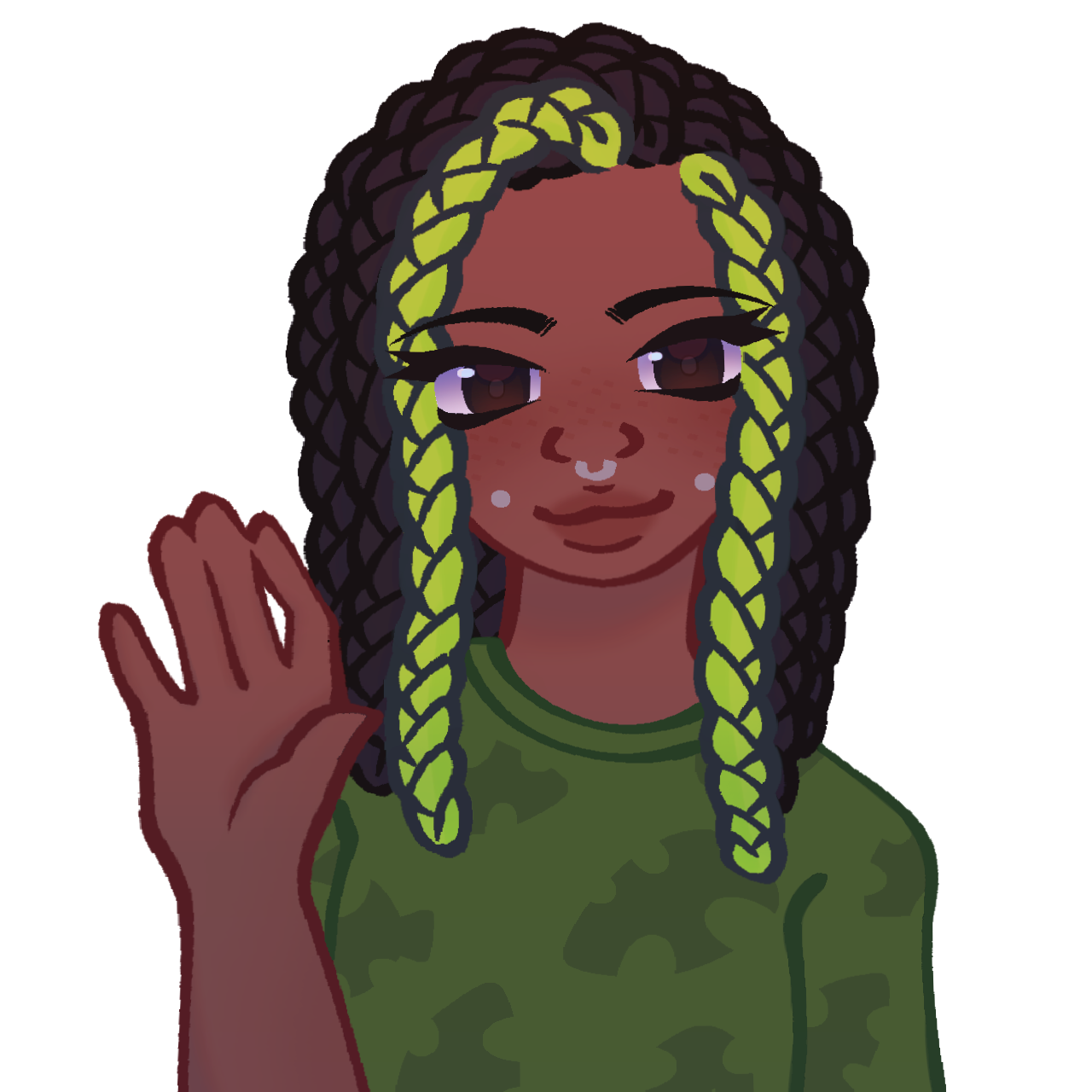 art by uucleo art by uucleo | |
| Information | |
| Names | Ẹde, Jadie |
| Occupation | Oracler |
| Birthday | April 9th |
| Pronouns | they/She |
| Labels |
|
Ẹdema «Jude» Ubọmwẹn is the sibling of Jude, Cade, and Coda; and child of Wybe.
She is an oracler
Lore
She is experienced in divining (cf. ogwɛga[1]). This originally started as a coping mechanism for anxiety, and at some point it started coming naturally to Her and thus doesn't take too much effort to do so.
Within Teens on Mana
Jade is an alraune[2], made with the seed of the kola.
In such magical settings, She has been placed under a certain charm since birth to have a human appearance and growth, and have Her own alraune existence suppressed.
Within MALIGNANCE
The same process was done to create Jade as the other children, using chlorophyll; instead.
Miscellaneous
Jade might also have been a dryad
She wears a crown as a reference to Serpula; because she was originally supposed to be based on Chlorocruorin rather than Chlorophyll
Ubọmwẹn means "the act of predicting through oracle"
Ẹde means Crown
Their favourite font is Harlow
Her color is 8CD82A
Alternate Blood: Chlorophylla, b, c1, c2, d, f, Pheophytin, Retinal, Bacteriochlorophylla, b, c, d, e, f, g
Footnotes and Sources
1Definition for ogwɛga, from A Concise Dictionary Of The Bini Language Of Southern Nigeria, by Hans Melzian
ogwɛga [ ˩ \ ˩ ] (1) a tree, Detarium senegalense, also called erh- õgwɛga [ ˩ ˥ (4-1) ˩ ]; the seed is broken in two parts and put on strings (four halves on each string) as an instrument for divining. There is another tree bearing the name ogwɛg-odĩ [ ˩ ˥ ˦ ˩ ], “the deaf ogwɛga”, Klainedoxa gabo- nensis; its fruit is used as a substitute for the ogwɛga [ ˩ \ ˩ ] proper, though it is not believed to be as useful for the oracle. Another substitute is the fruit of the axwɛxwɛ [ ˥ ˩ ˥ ] tree. (2) the method of divination (v. also ominigbɔ̃ [ ˩ ˩ ˩ ˩ ]) in which the seeds of the above-mentioned tree are used. The instrument of divination consists of four strings each of which contains fourhalves of the seed. At one end of each string a small bell (ɛɽoɽo [ ˥ ˥ ˥ ]) and some cowries are fastened. The diviner (ɔb-ogwɛga [ ˩ ˥ (4-1) ˩ ]) seizes one end of each string and throws them with the intention of turning them upside down. The subsequent arrange- ment of seeds is then analysed (v. eria [ ˩ ˥ ]) according to a certain code (itie [ ˩ ˥ ]), the criterion being the “open” or “covered” position of the seed-halves. The analysis is said to proceed at first from the right side to the left, and, after that, in the opposite direction, but as if the arrange- ment were looked at from the other end of the strings. The different positions have names, e.g. odĩ [ ˩ ˥ ] is a string with the two outer seed-halves showing their inside, and the two inner halves showing their cover. (Under the headings dealing with these positions, o. will mean “open”, and c. “covered”+, as reckoned from the top of the string.) The names of the positions are: odĩ [ ˩ ˥ ], oɣoi [ ˩ ˩ ] oɽuhu [ ˩ ˥ ˩ ], ɔɣae [ ˩ ˥ ], ogbi [ ˥ ˩ ] ako [ ˩ ˥ ], ose [ ˩ ˥ ], ohũ [ ˩ ˥ ] ɛrhoxwa [ ˩ ˥ ˩ ], ɛka [ ˩ ˥ ], ɔkã [ ˩ ˩ ] ɔʋa [ ˩ ˩ ], etuɽɛ [ ˩ ˥ ˥ ], ete [ ˩ ˩ ] ɔha [ ˩ ˥ ] and eɣitã [ ˩ ˥ ˥ ]. As the relations of two strings to one another are always considered, these names are usually com- bined, e.g. ɔh-ɔɣae [ ˩ ˥ ˥ ] (ɔha + ɔɣae). If both positions are the same, their name is followed by n-abe [ \ ˩ ] “combined”, e.g. ɔkã n-abe [ ˩ ˩ \ ˩ ]. The “code” of this divination gives a fixed sentence for each of these com- binations, and the task of the
diviner is to explain to his client the meaning of the sentences appropriate to the arrangements of seeds. As these represent certain typical situations in life, their corresponding names in the code are often used as idiomatic ( “deep”) expressions for these typical situations, v. eh-ɔɣae [ ˩ ˥ ˥ ] and ɔkãn-abe [ ˩ ˩ \ ˩ ]. The actual throwing of ogwɛga [ ˩ \ ˩ ] is done in the following way: “alligator-pepper” (ɛhĩ- ɛ̃do [ ˩ ˥ ˥ ˦ ]) is chewed and spat on the instrument, then the client holds uk-iha [ ˥ \ ˩ ], “the mes- senger of the oracle”, also called uta [ ˥ ˩ ], in front of his mouth and asks the master of the oracle (ɔka [ ˩ ˥ ]) his question. The ɔbo then touches all the sixteen seed- halves, saying: w-ɔɽ̃-ɛ̃ʋ̃ɛ n-ɔxaɽe (wɛ [ ˩ ]) [ / / ˩ ˥ / ˩ ] “do you know the word he has said?”, puts uk-iha [ ˥ \ ˩ ] between the strings and throws them so that the ɛɽoɽo [ ˥ ˥ ˥ ] and the cowries fall at his side.
2Alraune (5e Race) - D&D Wiki
Alraune are born under rare circumstances; it is only when the potent magic from the Feywilds seeps into the material plane and binds the soul of a recently deceased humanoid to a flowers' seed that they come into existence. Once all of the flowers' seeds are released into the soil, chances of survival are of course small. The infused seed, however, is capable of spending a long time in a "resting" state, waiting for the opportune moment to start growing. Once the seed germinates, it spends the first year growing into a bulb. It remains in the bulbous state, ever growing until reaching maturity and flowering into an alraune at around 5 years.