
Judith «Jude» Irẹnmwin
| Judith «Jude» Irẹnmwin | |
|---|---|
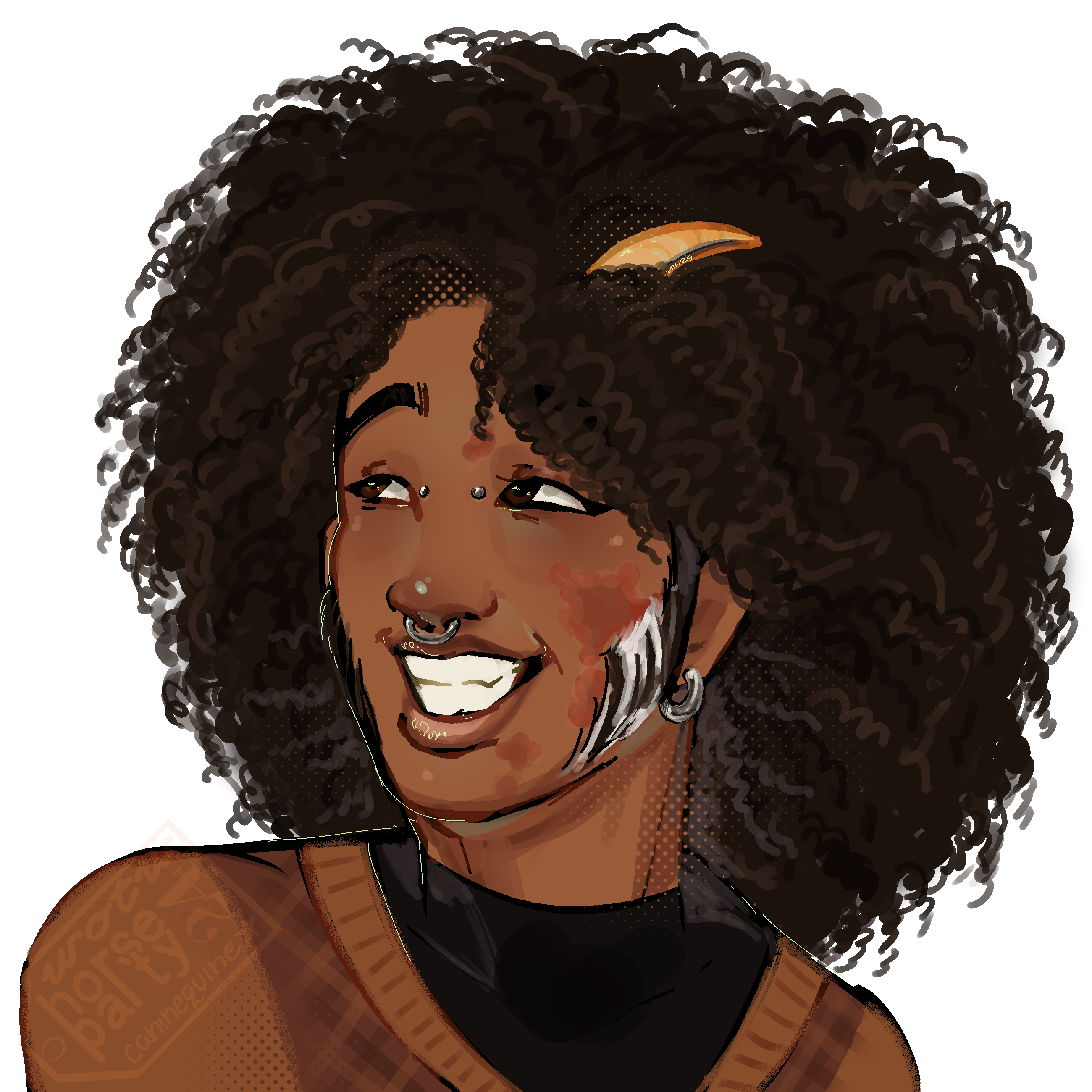 art by rocker art by rocker | |
| Information | |
| Occupation | Chemist |
| Birthday | September 21 |
| Pronouns | she/they |
| Labels |
|
Judith «Jude» Irẹnmwin is the sibling of Cade, Coda, and Jade; and child of Wybe.
Jude is, like their father, interested in science. Although she mainly focused on chemistry rather than biology.
She is resilient, observant and studios; but can be presumptive and irritable. Her main fear is fucking her own stuff up with an experiment-gone-wrong.
Lore
Their blood is still made from hæmoglobin, but she has sickle cell anemia.
The red blotches on her face are healed burn scars, and her silver piercings are created by her alchemical experiments. The hair regrowth on those scars lost their pigment.
Enjoys drinking whiskey
Within Teens on Mana
Her horns were created due to their own experiments, whether they be done through science or through magic.
On many occasions, Jude was engaging in several magics like alchemy, under the presumption of it being science. This has resulted in them being trained as an ɔbo[1] themselves.
Although not being actively aware of witchcraft, she does have intuition related to it; likely due to being fed aba[2] when they were young, as children of witches tend to be witches themselves.
She likely wasn't actively aware of witches or magic, due to literature related to it being rewritten as science because of social stigma. (e.g. witch doctors being referred to simply as doctors, …)
Within MALIGNANCE
Her horns were the creation of an experiment (and potentially other bodily modifications), done by Wybe.
Miscellaneous
Jude was supposted to have some vanadocytes
Their favourite font is Rockwell
Her color is E0555C
Alternate Blood: Myoglobin, Leghæmoglobin
Footnotes and Sources
1Definition for ɔbo, from A Concise Dictionary Of The Bini Language Of Southern Nigeria, by Hans Melzian
ɔbo 1 [ ˩ ˥ ] (pl. e-) a “doctor”; there are oracle-, witch- and ordeal- doctors as well as those who cure, or make rain. The oracle- doctors are composed of four different groups according to the different kinds of oracles; there are ɔb-ogwɛga [ ˩ ˥ (4-1) ˩ ], ɔb- ewawa [ ˩ \ ˩ ˩ ], ɔb-akpɛlɛ [ ˩ \ ˩ ˩ ],and ɔb-ɔɽ̃ɔ̃mila [ ˩ ˥ ˦ ˩ ˩ ]. The ɔb- ewawa may be an ɔbo n-ɔz-isɛ [ ˩ ˩ ˩ ˥ ˩ ] “a doctor who chooses seeds”, i.e. one who gives the name of a suspect to each one of several seeds (when trying to find out the perpetrator of an offence), and finds the guilty one by means of ewawa [ ˩ ˩ ˩ ]. The ordeal-doctors, ɔb-itã [ ˩ \ ˩ ] are ɔb-it-õfigbɔ̃ [ ˩ ˥ ˦ ˦ ˩ ] “palm- oil-ordeal-doctor”, ɔb-it-ẽbe [ ˩ ˥ ˦ ˧ ] “leaf-ordeal doctor”, or ɔbo n-ɔd-itã [ ˩ ˩ ˩ ˥ ˩ ] (one who knows all sorts of ordeals). The experts for the feather- and sasswood-ordeals have no special name besides that of ɔb-itã. The witch-doctor, ɔbo n-ɔwa n-azɛ̃ [ ˩ ˩ ˩ / ˩ ˥ ] “doctor who gives food to the witches”, also called ɔbo n-ɔy-ada [ ˩ ˩ ˩ ˥ ˩ ] “doctor who goes to the cross-roads”, leads negotiations with witches and pacifies them by gifts of food from his clients. The “curing doctor”, ɔb-odĩ [ ˩ ˥ ˩ ], bears no outward sign of his profession, but is usully very competent and cures people for money or for their services. A doctor who makes his diagnosis by looking into his patients’ eyes (in case of illness or “juju-trouble”) is called ɔbo n-ɔmi-ãɽo [ ˩ ˩ ˩ ˥ ˥ ˩ ] i.e. “a doctor who looks eye”. An antisocial individual working with “bad medicines” may be called ɔb-ɛrhia [ ˩ ˥ ˩ ] a “spoil- doctor”. A “doctor” who travels round the country and makes a living by it is called ɔbo n-ɔy-eria [ ˩ ˩ ˩ ˩ ˥ ] “a doctor who goes grazing”. The four types of oracle doctors are represented by different people. The ɔb-
ogwɛga [ ˩ ˥ (4-1) ˩ ] practises only that sort of oracle. Other doctors may know the method, but they are not called ɔb-ogwɛga. If another doctor does not know the ogwɛga, he may have to call in an ɔb-ogwɛga. The ɔb-ogwɛga is paid for his work, but he is also a farmer, as the money he earns is not a sufficient liveli- hood. The oracle is learned from another ogwɛga doctor (without staying with him); itie [ ˩ ˥ ] (the code) is said to take at least three months to learn. After this, eria [ ˩ ˥ ], the analysis of the code-words, is learnt. That is said to take more than six months. If a man is too keen on learning eria so that he starts on it before knowing itie pro- perly, he is supposed never to learn itie correctly. Then he is called: ɔʋ̃a n-ɔgu-eria xɛ‿iha [ ˩ ˩ ˥ ˥ ˥ ˦ ˩ ˥ ˩ ] “a man who knows analysis waits for the oracle, i.e. the calling out”. An ewawa learner must be a servant under a doctor. The ewawa doctor, who is always an Osũ [ ˩ ˥ ] priest, also undertakes cures, but they are not as good as the ɔb-odĩ. Most of them also give food to witches. Their servant is called ohãgbã [ ˩ ˩ ˩ ] or ɔwaisɛ [ ˩ ˩ ˩ ]. The ap- prenticeship takes four to seven years because the pupils learn cures at the same time. Ewawa doctors are payed with money and they only farm when they have a big family. They make many charms, e.g. some for traders ensuring good husiness, some warding off danger for travellers, some against witches for sick people, etc. Especially
a charm “mentioning a man’s name” (ɛb-usueni [ ˩ \ ˩ ˩ ] “name- mentioning charm”) and a charm speaking by itself (oʋi‿ɛɽ̃i^ ʋ̃i [ ˩ ˥ ˥ ˦ ˩ ] “son of the Under- world”) procure them more clients than the other oracle doctors have. This fact, together with their acting as witch doctors, enables them to make a living by being doctors only, without additional farm work. Their knowledge of herbs is, however, said to be smaller than that of the eb-ɔɽ̃ɔ̃mila [ ˩ ˥ ˦ ˩ ˩ ]. An ɔb-akpɛlɛ [ ˩ \ ˩ ˩ ] is mostly an Olokũ [ ˥ ˥ ˦ ] priest, i.e. not a priest at a public shrine, but he has a bigger Olokũ shrine in his house than an ordinary Olokũ shrine. Many of his clients come to his Olokũ shrine and bring things for the yearly Olokũ sacrifice (eh-olokũ [ ˩ ˥ ˥ ˦ ]). The oracle method is learnt in about six months’ time. During this time the pupil keeps his akpɛlɛ [ ˩ ˩ ˩ ] in a pot at his Olokũ shrine (which nearly every adult possesses). Charms are also put into the pot, and the akpɛlɛ has first been charmed by the teacher, a full communal Olokũ priest. Afterwards the akpɛlɛ is put on an ukpabɔ [ ˩ ˩ ˩ ] tray and taken to some cross-roads (ada [ ˩ ˩ ]) where it is charmed again and buried with the charm for a fortnight “in order to see the truth”. (Ada being a meet- ing place for witches, spirits, etc., anything hidden there sees them.) Akpɛlɛ and Ogwɛga have to be familiar with witches be- cause they procure food for the witches by indicating pacifica-
tion sacrifices, ese [ ˩ ˩ ]. After the fortnight, the pupil, having learnt his craft, takes it out and is an ɔb-akpɛlɛ. The ɔb-ɔɽ̃ɔ̃mila must be a “priest” of Ɔɽ̃ɔ̃mila [ ˩ ˥ ˩ ˩ ], i.e. Ifa (Yoruba). (But there are no public shrines or priests of Ɔɽ̃ɔ̃mila.) Ɔɽ̃ɔ̃mila is the Yoruba god of palm kernels (and divination), and people from Akurɛ e.g. are more expert in this method than Bini people. A full babalawo [ ˩ ˩ ˥ ˥ ] (Yoruba name for the Ɔɽ̃ɔ̃mila priest) gathers the kernels from the base of ivĩ‿ɔ̃ɽ̃ɔ̃mila [ ˥ ˥ ˥ ˦ ˩ ˩ ], “Ɔɽ̃. kernels”, a special sort of oil palm, and gives them to the pupil. The pupil and his family smoothe the kernels by means of a grindstone, wash them with a charm and keep them for three months in a pot of oil. This is called ɔvi-ɔɽ̃ɔ̃mila [ ˩ ˩ ˥ ˦ ˩ ˩ ] “he has taken the Ɔɽ̃ɔ̃mila” (pl. verb). During this time small sacrifices are made to them until the pupil is (financially) able to “take” them. If he has no means he must possibly leave them in the pot for a year. At last, big sacrifices are made over a period of a fortnight during which time the pupil must procure an axwɛxwɛ [ ˥ ˩ ˥ ], i.e. oracle in- strument, of his own. Then the Ɔɽ̃ɔ̃mila are taken out and are afterwards put on an ukpo [ ˥ ˩ ] (mud bed) on which many cloths have been spread, forming a heap with a shallow cavity at the top. Parrot-tail-feathers are, among other things, added as adornments. The babalawo asks the kernels whether the pupil will live long and be prosperous
(i.e. have many children). Only after this installation of the Ɔɽ̃ɔ̃mila kernels is the teaching started which takes more than a year, and at the end of which the pupil becomes an ɔb- ɔɽ̃ɔ̃mila. Some of these doctors are farmers, some traders. They also concern themselves with cures, and they also learn about medicines. The oracle plays a part in their cures by naming the leaves to be used in special cases (by quoting previous in- stances). The money given to the ɔb-ɔɽ̃ɔ̃mila does not enable him to live on his practice as is the case with ɔb-ewawa. Ordeal doctors are not priests.